
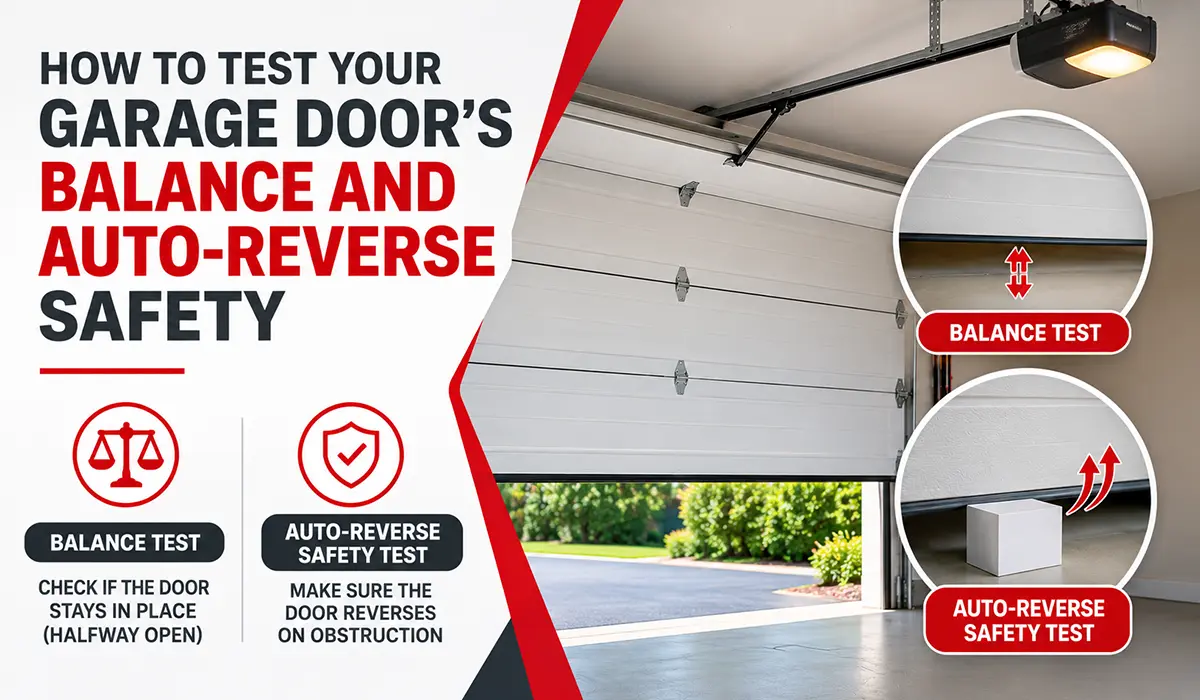
How to Test Your Garage Door’s Balance and Auto-Reverse Safety
You can test your garage door in about ten minutes with no tools except a 2×4. For the balance test, pull the red release cord with the door closed and lift the door by hand to the halfway point. A balanced door stays there. For the auto-reverse test, lay a 2×4 flat under the door and close it. The door should touch the board and go back up. Do both tests once a month, and call a professional if the door fails either one.
Before You Start
Set aside about ten minutes. You need a 2×4 board, a clear floor and your remote. Read these rules first:
- Never touch the springs, cables, pulleys or brackets. They are under extreme tension. You are only testing, not adjusting.
- Keep people and pets away from the door. Do not stand or reach under it while it moves.
- Find your red emergency release cord. It hangs from the opener rail and disconnects the door from the opener. How you pull it depends on your opener, so check your manual.
- Clear the area. Move bikes, bins and boxes out of the door’s path.
If you are ever unsure, stop and call a technician. These tests are meant to find problems early, not to fix them.
How to Test Your Garage Door’s Balance
A balanced door is held up by its springs, not by the opener. This test shows how well the springs are doing their job.
- Close the door fully.
- Pull the red release cord to disconnect the door from the opener.
- Lift the door by hand. It should move easily and smoothly, even with one hand. If it sticks or scrapes, the tracks or rollers may need cleaning and lubricating.
- Lift it to about halfway, around three to four feet, and let go carefully. Keep your hands clear of the sections. A balanced door stays where you left it or drifts very slowly.
- Try one or two other heights. The door should hold at each one.
- Lower the door by hand and reconnect the opener using the method in your manual.
What a bad result looks like: the door slams down, shoots up, or feels very heavy to lift. That means the door is out of balance. A worn or broken spring or cable is the usual cause. Stop testing and call a professional. Do not try to adjust the springs yourself.
Balance matters for more than comfort. An unbalanced door strains the opener, can fall on someone without warning, and may not reverse when it should. If you are not sure what type of springs your door has, read our guide to torsion vs extension springs.
How to Test Your Garage Door’s Auto-Reverse Safety
The auto-reverse feature makes the door go back up if it hits something while closing. Test it with a 2×4, not a roll of paper towels. The industry association DASMA says a 2×4 laid flat is the correct test object, because a paper towel roll can compress without proving the door reverses at the right height. A door should reverse when it reaches about 1.5 inches above the floor, and a flat 2×4 is that height.
- Open the door fully and make sure the opener is connected.
- Lay a 2×4 flat on the floor, centered in the door’s path.
- Stand clear and press the close button on the remote or wall control.
- Watch the door. It should touch the board and reverse right away, then go back to fully open.
- Remove the board and close the door normally to make sure it still shuts all the way.
If the door does not reverse: press the stop or open button, then pull the red release cord. Leave the door disconnected and call a technician. Do not turn up the force setting to make it work. Raising the force on an unbalanced door only makes the problem more dangerous.
How to Test the Photo Eye Safety Sensors
Photo eyes are the two small sensors on either side of the door, about 4 to 6 inches above the floor. They send a beam across the opening. If something blocks the beam, the door should stop and reverse.
- With the door open, press the close button.
- While the door is closing, pass a broom handle or other object across the beam. Do not use your body.
- The door should stop and go back up.
If it ignores the beam, check these first:
- Wipe both lenses clean of dust, cobwebs and frost
- Look at the indicator lights. Both should be steady, not blinking
- Make sure the sensors point at each other and are not knocked out of line
If the lights still blink or the door will not close, see our LiftMaster sensor and blink code guide. If the sensors work but the door still does not respond, it is time for a service call.
What Your Test Results Mean
| Test | A pass looks like | A fail looks like | What to do |
|---|---|---|---|
| Moves by hand | Lifts easily with one hand | Sticks, scrapes or binds | Clean and lubricate tracks, rollers and hinges, then retest. Call a pro if it persists |
| Balance | Stays at the halfway point | Slams down, shoots up or feels very heavy | Stop. Call a pro. Do not touch the springs |
| Auto-reverse | Reverses when it touches the 2×4 | Stops on the board or keeps pushing | Disconnect the opener and call a pro |
| Photo eye | Stops and reverses when the beam is blocked | Keeps closing, or the lights blink | Clean and realign the sensors, then call a pro if it continues |
A door that fails the balance test often fails the auto-reverse test too, because an unbalanced door puts the wrong load on the opener. If both fail, fix the balance first.
How Often Should You Test?
Test once a month. The U.S. Consumer Product Safety Commission recommends checking the door and opener every 30 days, and DASMA also recommends testing reversal after any repair or adjustment. That includes a new opener, a spring or cable replacement, and a change to the force or travel settings.
In Calgary, add a test after a hard cold snap. Extreme cold stresses springs, cables and seals, so problems often show up on the first -30 morning. Our fall garage door checklist is a good time to run all three tests before winter, and our guide to how extreme cold affects your garage door in Alberta explains what to watch for. If your door sticks to the floor in winter, read how to free a garage door frozen to the concrete before you test.
When to Call a Professional
Call a technician if your door fails any test, feels heavy, makes new noises, or if you are not sure how to read the result. A yearly professional tune-up also catches problems before they turn into a breakdown.
Here is what common fixes cost with Alberta Garage Door Services in Calgary:
| Problem | Fix | Our price |
|---|---|---|
| Door is a little out of balance, no broken parts | Tune-up with spring tension check and balance, lubrication and opener adjustment | From $149 + GST |
| Broken or worn spring | Garage door spring replacement | $349 + GST |
| Frayed or slipped cable | Garage door cable replacement | From $199 + GST |
| Opener fault, not reversing | Opener repair | $249 + GST |
Our technician tests the balance, the reversal and the sensors, tells you what he finds, and gives you a price before any work starts. Prices are our Calgary rates as of November 2026.
Garage Door Balance and Auto-Reverse Test: Frequently Asked Questions
How do I know if my garage door is balanced?
Close the door, pull the red release cord, and lift the door by hand to about halfway. A balanced door stays where you leave it or drifts very slowly. If it slams down, shoots up or feels very heavy, it is out of balance and needs a technician.
How do I test my garage door’s auto-reverse?
Lay a 2×4 flat on the floor under the door and close the door with the remote. The door should touch the board and go back up. If it keeps pushing down, press stop, pull the release cord and call for service.
Why use a 2×4 instead of a paper towel roll?
A flat 2×4 sits at about 1.5 inches, the height where the door must reverse. DASMA says a paper towel roll can compress and does not prove the door reverses at the right point.
How often should I test my garage door?
Once a month, and again after any repair, opener change or setting adjustment. In Calgary, test after a major cold snap as well.
Can I fix an unbalanced garage door myself?
No. Balance is set by spring tension, and springs and cables are under extreme force. Adjusting them without training can cause serious injury. Call a professional.
What should I do if my garage door does not reverse?
Stop using the opener, pull the red release cord, and keep people and cars clear of the door. Then call a technician. Do not raise the force setting to try to make it work.
Need Your Garage Door Checked in Calgary?
If your door failed a test, or you would rather have a professional run all three, Alberta Garage Door Services can help. We have more than 13 years of experience, we are licensed, bonded and insured, and we serve Calgary, Airdrie, Chestermere, Cochrane, Okotoks, Strathmore and High River.
Call 587 223 5757 or request a free quote.
