Belt vs Chain vs Screw Drive: How to Choose a Garage Door Opener
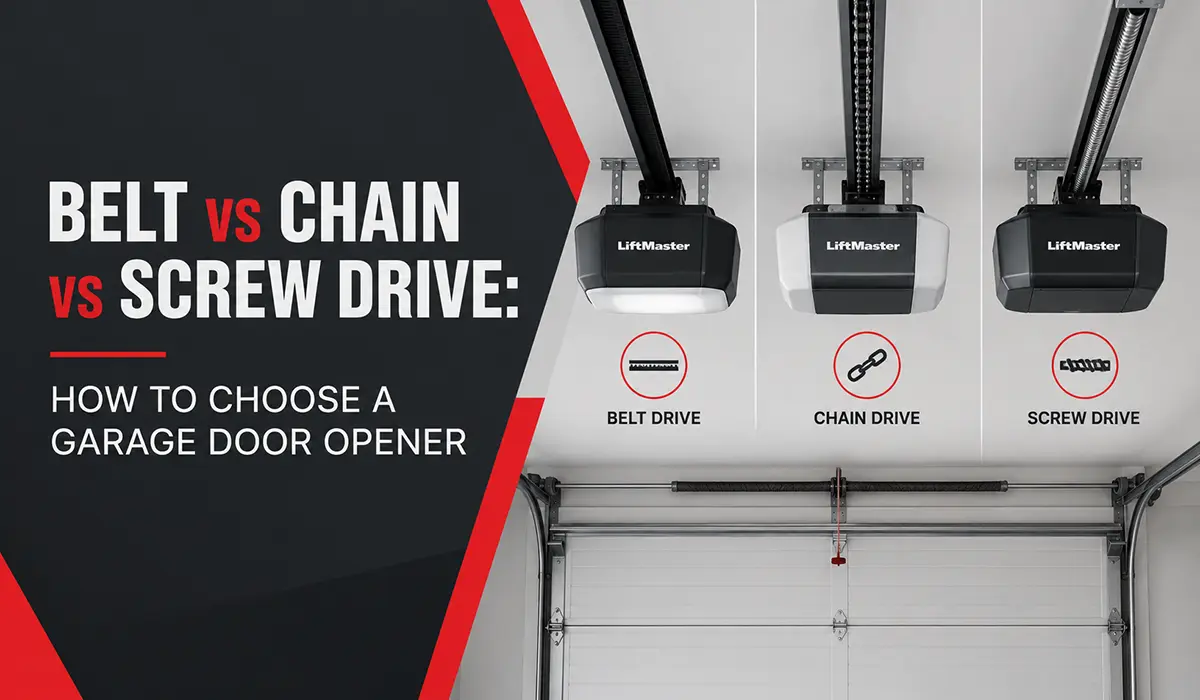
The drive is the part of a garage door opener that does the actual lifting, and it is the choice that decides how loud your opener is, how much it costs, and how well it copes with a heavy door. There are three main types, and the quick version is simple. A belt drive is the quietest and the best pick for an attached garage or one with a room above it. A chain drive is the toughest and most affordable, and it suits a detached garage where a bit of noise does not matter. A screw drive sits in the middle, strong and fast, and works well on heavy or wide doors.
That covers most people. But the drive is only half the story. The motor behind it, how much power it has, and features like battery backup matter just as much, especially through an Alberta winter. Here is the full picture so you can match an opener to your garage and not overpay for things you do not need.
Quick comparison of garage door opener drive types
| Drive type | Noise | Cost | Strength | Maintenance | Best for |
|---|---|---|---|---|---|
| Belt | Very quiet | Higher | Good for most doors | Low | Attached garages, rooms above the garage |
| Chain | Loud | Lowest | Excellent, handles heavy doors | Occasional lube | Detached garages, budget, oversized doors |
| Screw | Moderate | Middle | Very strong, fast | Occasional lube | Heavy or wide single-panel doors |
Prices vary with the motor, the horsepower, and the smart features you add, so treat this as a guide rather than a quote.
The three drive types, explained
Chain drive
A chain drive uses a metal chain, much like a bicycle chain, to pull the door up and down along the rail. It is the oldest and most common design, and it is the most affordable.
The strength is its main appeal. A chain drive has no trouble with heavy or oversized doors, and it lasts for years with only occasional lubrication. The downside is noise. Metal moving against metal creates rattle and vibration, and that sound carries into the house. If the garage is detached, or you do not have bedrooms nearby, the noise is a non-issue and the low price is hard to beat.
Best for: detached garages, tight budgets, and heavy doors where quiet operation is not a priority.
Belt drive
A belt drive works the same way as a chain drive, but it uses a reinforced rubber belt instead of a metal chain. That single change makes it the quietest option on the market.
Because there is no metal chain slapping against itself, a belt drive runs smoothly and softly, with very little vibration passing into the home. It also needs little maintenance and handles the weight of most residential doors without complaint. You pay a bit more than you would for a chain drive, and for a very heavy custom door you may want a reinforced belt or a chain instead. For the average Calgary home, though, especially one with a garage under or beside a living space, the belt drive is usually the one people are happiest with.
Best for: attached garages, homes with a room above or next to the garage, and anyone who values a quiet door.
Screw drive
A screw drive uses a threaded steel rod that turns to move the trolley along the rail. It has fewer moving parts than the other two, which appeals to people who want a simpler mechanism.
Screw drives are strong and fast, and they lift heavy and wide doors with ease. Noise sits between the other two, quieter than a chain but not as silent as a belt. The screw itself needs a light greasing now and then to run smoothly. Older screw drives had a reputation for struggling in temperature extremes, which mattered in Alberta, though modern designs with lined trolleys handle our cold far better than they used to.
Best for: heavy or wide doors, and garages where lifting strength and speed matter more than absolute quiet.
Which opener is best for an attached garage?
If your garage is attached to the house, or there is a bedroom or office above or beside it, noise should sit near the top of your list. This is where a belt drive earns its price. The soft, low-vibration operation means an early start or a late arrival home does not wake the household.
A chain drive on an attached garage is not wrong, and plenty of homes run one happily, but the rattle is noticeable through shared walls and floors. If you already have a chain drive and the noise bothers you, the fix is not always a new opener. Worn rollers, dry hinges, and loose hardware often cause more of the racket than the drive itself, and a proper service can quiet things down. Our team can check that as part of opener repair and replacement.
Garage door openers and Alberta cold
Alberta winters put more strain on an opener than most people realize. In deep cold the door itself gets stiffer, the grease in the tracks thickens, and the springs work a little harder, so the opener has to pull against more resistance than it does in July. In a hard frost the door can even end up stuck or frozen to the garage floor, which forces the opener to work harder still.
Choose enough power. An opener that is comfortably strong for your door will handle a cold morning without straining. This matters even more with a heavier insulated door, which puts more weight on the motor.
Consider battery backup. Alberta gets its share of winter storms and power outages, and a battery backup lets you open and close the door when the power is out, so you are not stuck outside in the cold or trapped without your vehicle. Many modern openers include this as a built-in feature.
Keep it lubricated. Cold-weather grease on the rollers, hinges, and rail keeps the whole system moving freely, which takes load off the opener and is a simple part of your seasonal maintenance routine. A yearly tune-up before winter is cheap insurance.
It is not just the drive: motor power and DC vs AC
Two openers with the same drive type can perform very differently depending on the motor.
Horsepower: For a standard single door, a half-horsepower motor is usually enough. For a double door, a heavy insulated door, or a wide door, three-quarter horsepower or more gives you smoother, more reliable lifting with room to spare on a cold morning. Undersizing the motor is a common mistake that shortens an opener’s life, and it often shows up as an opener that strains or stalls partway through lifting the door.
DC vs AC motors: Older openers use AC motors, which run at a single speed and start and stop with a jolt. Newer openers often use DC motors, which are quieter, allow a soft start and soft stop that is gentler on the door, and usually come with battery backup. Most of the quietest belt drives on the market are DC. If quiet, smooth operation is the goal, the motor type matters as much as the belt.
Smart features worth having
Modern openers offer more than lifting. A few of these are genuinely useful in a Calgary home.
- Wi-Fi control: Open, close, and check your door from your phone, and get an alert if you left it open. Handy in winter when you would rather not walk out to check.
- Battery backup: Covered above, and worth repeating for our winters.
- Motion-sensing lights: The opener light turns on as you enter, which is a small thing that gets appreciated on dark December afternoons.
- Rolling-code security: The remote code changes each time you use it, which stops anyone from copying your signal. Pair it with a fresh keypad or remote for easy, secure access.
What about wall-mount and direct drive openers?
Two newer designs are worth knowing about, even though they sit outside the classic three.
A wall-mount opener, sometimes called a jackshaft, mounts on the wall beside the door rather than on the ceiling. It drives the torsion bar directly, runs very quietly, and frees up all the ceiling space above the door, which suits garages with high or sloped ceilings or overhead storage. It costs more than a standard opener.
A direct drive opener has the motor travel along a fixed chain built into the rail, so there is only one moving part. It is about as quiet as a belt drive and very reliable. Both are good options if quiet operation and low maintenance are your priorities and you have room in the budget.
How to choose
Work down this list and stop at the line that fits your situation.
- Attached garage, or a room above or beside it: belt drive, ideally with a DC motor. Quiet is worth it here.
- Detached garage, tight budget: chain drive. Strong, dependable, and easy on the wallet.
- Heavy or wide door, and you want speed: screw drive, or a belt drive with three-quarter horsepower.
- High ceilings or overhead storage: consider a wall-mount opener.
Whatever drive you choose, size the motor to your door, and add battery backup if winter outages are a concern where you live.
The bottom line
For most Calgary homes with an attached garage, a belt drive opener with a DC motor is the choice that keeps the house quiet and handles our winters well. A chain drive still makes great sense for a detached garage on a budget, and a screw drive is a solid middle ground for heavier doors. Match the motor’s power to your door, think about battery backup for winter, and keep the whole system lubricated so the opener is not fighting a stiff door in the cold.
If you would like help picking or installing the right opener, the team at Alberta Garage Door Services works on all major opener brands and drive types across Calgary, Airdrie, Chestermere, Cochrane, Okotoks, and the surrounding area. Contact us for a free quote or call 587 223 5757.
Frequently asked questions
What is the quietest garage door opener?
A belt drive opener is the quietest, because it uses a reinforced rubber belt instead of a metal chain, so there is far less rattle and vibration. Pairing a belt drive with a DC motor, which adds a soft start and stop, gives you the quietest operation available. This makes it the best choice for an attached garage or one with a room above it.
Belt vs chain garage door opener: which is better?
It depends on your garage. A belt drive is quieter and smoother, which is better for attached garages, while a chain drive is more affordable and handles heavy doors well, which suits detached garages. If noise is a concern, choose belt. If budget is the priority and the garage is detached, chain is a dependable pick.
Are screw drive garage door openers good in cold weather?
Older screw drive openers were sensitive to temperature swings and could slow down in extreme cold. Modern screw drives with lined trolleys handle Alberta winters much better, though they still benefit from occasional greasing to stay smooth. For the coldest climates, a belt or chain drive with enough horsepower is often the safer choice.
What horsepower garage door opener do I need?
A half-horsepower motor is usually enough for a standard single door. For a double door, a heavy insulated door, or a wide door, choose three-quarter horsepower or more for smoother, more reliable lifting, especially on cold mornings when the door is stiffer. Undersizing the motor is a common mistake that shortens an opener’s life.
How long do garage door openers last?
Most garage door openers last around 10 to 15 years with basic care. Life depends on how often the door is used, whether the opener is sized correctly for the door, and how well the door and hardware are maintained. A door that is out of balance or poorly lubricated wears out an opener faster.
Do I need a belt drive opener for an attached garage?
You do not strictly need one, but it is the best fit. An attached garage shares walls and often a ceiling with living space, so the quiet operation of a belt drive keeps the noise out of the house. A chain drive will work, but its rattle is more noticeable through shared walls and floors.
Is a chain drive opener bad?
Not at all. A chain drive is strong, reliable, and the most affordable option, and it handles heavy doors with ease. Its only real drawback is noise, which is why it is best suited to detached garages rather than ones attached to living space.
What is a battery backup on a garage door opener and do I need one?
A battery backup lets the opener run during a power outage, so you can still open and close the door when the electricity is out. In Alberta, where winter storms and outages happen, it is a useful feature that keeps you from being stuck outside or without your vehicle. Many modern DC openers include it built in.
Can I replace just the opener without replacing the door?
Yes. The opener and the door are separate systems, so you can upgrade to a quieter or more powerful opener while keeping your existing door. A technician will confirm the new opener is sized correctly for your door’s weight and that the door is properly balanced before installing it.
What is a wall-mount (jackshaft) garage door opener?
A wall-mount opener installs on the wall beside the door instead of on the ceiling, and it drives the torsion bar directly. It runs very quietly and frees up ceiling space, which suits garages with high or sloped ceilings or overhead storage. It costs more than a standard opener but is a strong choice where quiet and space matter.
