
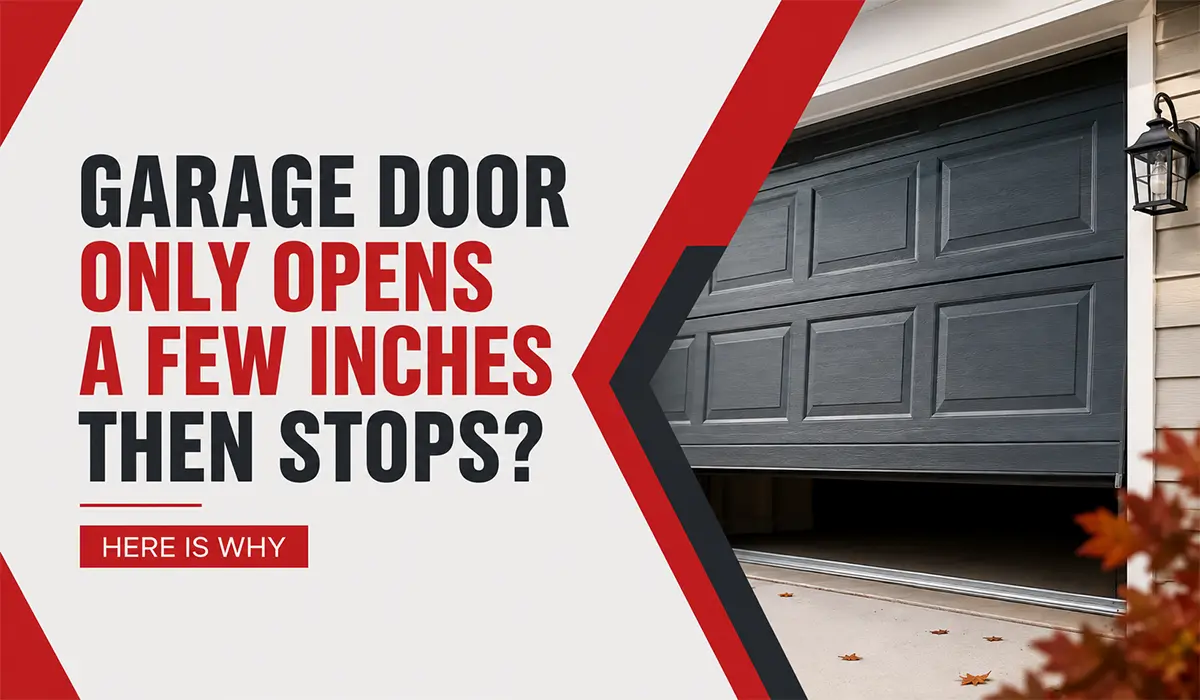
Garage Door Only Opens a Few Inches Then Stops? Here Is Why
Garage Door Only Opens a Few Inches Then Stops: What It Means
If your garage door lifts a few inches off the ground and then stops, the most likely cause is a broken torsion spring. It is one of the most common calls we get in Calgary, and there is a specific reason the door behaves this way. Understanding it tells you what to do next, and, just as importantly, what not to do.
Running the opener against a broken spring is how a straightforward repair turns into an expensive one.
Why the door stops after a few inches
Here is the part most people do not know. Your opener does not lift the door. It only guides it. The actual lifting is done by the springs, usually mounted on a metal bar above the door. They store energy when the door closes and release it to raise the door, which on a double insulated Calgary door can weigh over 200 pounds. When a spring breaks, that lifting force is gone. The opener, designed only to guide the door, tries to raise the full dead weight on its own. It manages a few inches, senses the load is far heavier than it should be, decides something is wrong and stops. That cut-out is doing its job. It is telling you the spring has failed.
How to confirm it is the spring
- Did you hear a bang recently? A torsion spring failing sounds like a gunshot in the garage. If you heard that in the last day or two and the door quit afterward, it is almost certainly the spring.
- Look at the spring above the door. The coil should be one continuous tight spiral. A break shows as a two or three inch gap with the ends separated.
- Try lifting by hand. Pull the red release cord to disconnect the opener, then try to raise the door. A door on good springs feels like about ten pounds. A door with a broken spring feels like the full weight, because nothing is helping you.
Other possible causes
A broken spring is the most common reason by far, but not the only one. If the spring looks intact, the door stopping short could also be:
- Debris, ice or a bent section in the track blocking the rollers.
- A cable that has slipped off the drum or snapped, which makes the door go crooked as well as stop.
- Opener travel limits set wrong, though this usually stops the door at the same point every time rather than after a sudden failure.
- In deep cold, the bottom seal frozen to the concrete, holding the door down while the opener gives up.
The hand lift test sorts most of this out. If the door is heavy by hand, it is a spring or cable. If it lifts easily by hand but the opener will not raise it, the problem is more likely the opener or an obstruction.
What not to do
Every time the opener strains against a dead door, you risk burning out the motor, snapping a cable or bending the top section. A simple spring job can become several hundred dollars more once the opener and cables are involved. An underpowered opener can also struggle with a heavy or cold-stiffened door. Our opener guide explains whether your opener has enough power for your door.
A torsion spring holds enough stored energy to break bones, and people are seriously hurt winding them every year. It is not a job to learn from a video. If you need the car out, pull the red release cord and lift the door by hand with a second person, because it will be heavy, then prop it safely.
How the repair works
A technician will confirm the broken spring, check the cables, and replace the spring with one sized to your door’s weight. If your door has two springs and one has gone, replacing both at once is usually the better call, because they are the same age and have done the same number of cycles, so the second is often close to failing too. Doing both in one visit avoids a second call-out within months.
One local note: springs wear out sooner here than the national average suggests. Calgary temperature swings and Chinooks put the metal through constant expansion and contraction, so a spring rated for seven to ten years often gives out at five to eight in this climate. That is a reason to have the door checked once a year, not a reason to worry.
Frequently asked questions
Can I still use my garage door if a spring is broken?
You should not. Running the opener against a broken spring can burn out the motor, snap a cable or bend a panel. Lift it by hand only if you must move a vehicle, then leave it be until it is repaired.
How do I know if it is the spring or the opener?
Disconnect the opener with the red cord and lift by hand. If the door is very heavy, it is a spring or cable. If it lifts easily but the opener will not raise it, the problem is more likely the opener.
Why did my spring break in winter?
Cold makes springs more brittle and the door harder to move, so springs often fail on the coldest mornings. Calgary freeze thaw cycles also shorten spring life compared with milder climates.
Should I replace one spring or both?
If the door has two and one broke, replacing both is usually wiser. They are the same age and have taken the same load, so the second is often near failing, and doing both together saves a second call-out.
How long does a spring replacement take?
Usually under two hours for a standard residential door, including balancing and a safety check.
Is it safe to replace a garage door spring myself?
No. Torsion springs are under extreme tension and can cause serious injury. This is a repair to leave to a trained technician.
Door stuck after a few inches? We can usually fix it the same day.
Our technicians carry the common spring sizes and confirm the price before starting. We serve Calgary and the surrounding towns. Call 587 223 5757 or request a quote online.
