
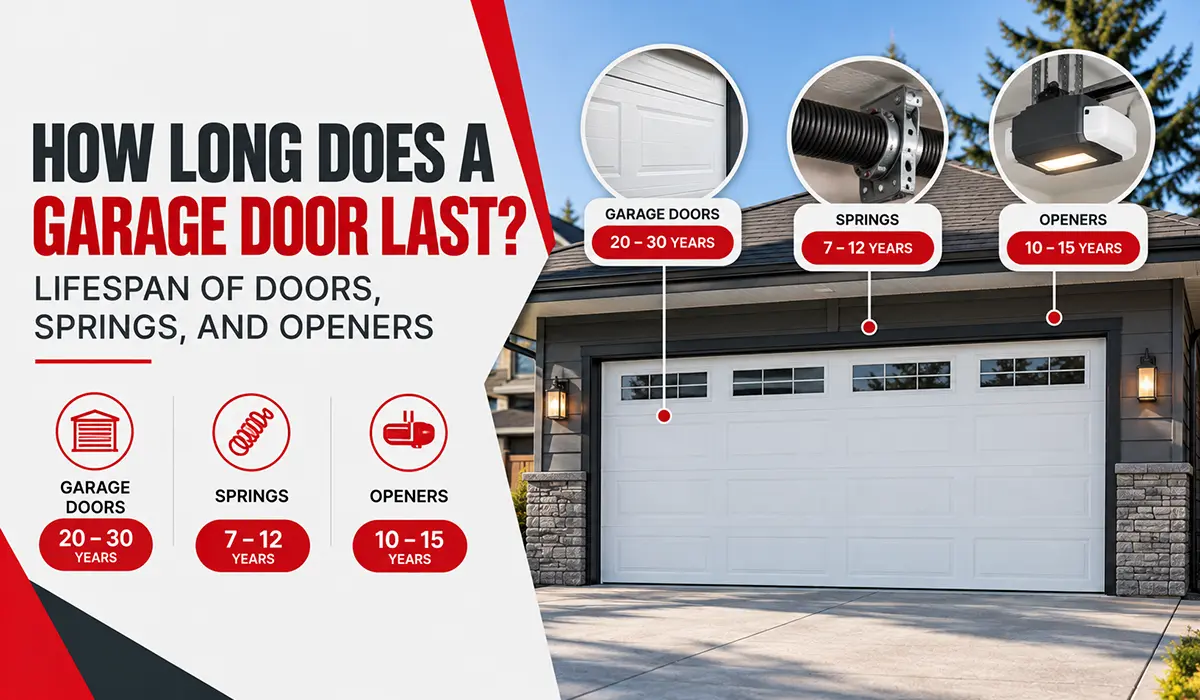
How Long Does a Garage Door Last? Lifespan of Doors, Springs, and Openers
A garage door usually lasts 15 to 30 years, depending on the material, how often you use it and how well it is looked after. The parts inside wear out much sooner than the door itself. Torsion springs often fail after 7 to 14 years on a standard 10,000 cycle rating, and openers usually run 10 to 15 years. In Alberta, cold snaps, road salt, hail and daily use can cut those numbers if the door is not maintained.
This guide breaks down how long each part lasts, what wears them out in Calgary, the warning signs to watch for, and how to decide between a repair and a new door.
Garage Door Lifespan at a Glance
| Part | Typical lifespan | What shortens it | Our Calgary price |
|---|---|---|---|
| Whole door (steel) | 20 to 30 years | Rust, dents, hail, poor balance | From $2,200 + GST |
| Torsion springs | 7 to 14 years (10,000 cycles) | High daily use, no lubrication, cold snaps | $349 + GST |
| Cables | 10 to 15 years | Rust, rubbing, off-balance door | From $199 + GST |
| Rollers | 5 to 10 years | Dry bearings, dirt, heavy use | From $199 + GST |
| Weatherstripping and bottom seal | 3 to 10 years | Freezing, cracking, sun | From $199 + GST |
| Opener | 10 to 15 years | Out-of-balance door, heat, heavy use | Repair $249 + GST, new from $749 + GST |
| Panels | Life of the door | Dents, rust, delamination | From $449 + GST |
| Remotes and keypads | 5 to 10 years | Dead batteries, cold, wear | Ask for a quote |
These are typical ranges, not guarantees. A door that is used six times a day and never serviced will wear faster than one used twice a day with a yearly tune-up. Prices are from Alberta Garage Door Services, include no weekend surcharge and are plus 5% GST.
How Long Does a Garage Door Last by Material?
| Material | Typical lifespan | Notes for Alberta |
|---|---|---|
| Steel | 20 to 30 years | Most common. Insulated steel handles cold well. Dents and rust at the bottom are the main issues. |
| Wood | 15 to 30 years | Needs regular sealing or painting. Dry air and sun dry it out. |
| Aluminum | 20 years or more | Does not rust but dents easily. Often used in full view doors. |
| Fibreglass | 15 to 20 years | Light, but can crack in extreme cold and fade in strong sun. |
| Vinyl | 20 to 30 years | Resists dents and rust. Colour choices are limited. |
| Composite | 20 to 30 years | Wood look with less upkeep. Costs more up front. |
A door’s lifespan depends on its parts more than its panels. A 25-year-old steel door with fresh springs, rollers and seals can work as well as a new one. A 10-year-old door that has never been serviced can feel worn out.
How Long Do Garage Door Springs Last?
Springs do the heavy lifting. A standard torsion spring is rated for about 10,000 cycles. A cycle is one full open and one full close. If you open the door about four times a day, that is roughly 7 years. Fewer trips stretch that out.
| Cycles per day | 10,000 cycle spring | 25,000 cycle spring |
|---|---|---|
| 2 | About 13.7 years | About 34 years |
| 4 | About 6.8 years | About 17 years |
| 6 | About 4.6 years | About 11.4 years |
| 10 | About 2.7 years | About 6.8 years |
Count your own cycles. Every time you leave, come home, take out the bins or grab something from the garage, that is a cycle. Families with several drivers can reach six to ten cycles a day without noticing.
Cold weather is when many worn springs finally give out. Steel is stressed as the temperature drops, and a spring that was already near the end of its life can break on the first -30 morning.
Ways to get more from springs:
- Upgrade to high-cycle springs. Springs rated for 20,000 to 25,000 cycles last two to three times longer for a modest price increase. If you use the door often, they are worth it.
- Lubricate twice a year. Dry springs rub and wear.
- Keep the door balanced. An unbalanced door strains the springs.
- Replace springs as a pair. If one breaks, the other is close behind. Doors with two springs should have both replaced.
- Convert older extension spring systems. A torsion conversion (Torquemaster) costs $549 + GST and is more stable and safer than extension springs.
Never try to replace or adjust springs yourself. They hold enough stored energy to cause serious injury. Spring replacement from Alberta Garage Door Services is $349 + GST. See our guide to garage door spring replacement costs in Calgary for what is included.
How Long Do Garage Door Openers Last?
Most openers last 10 to 15 years. The motor, gear and circuit board wear with use and heat. A door that is out of balance makes the opener work harder, which shortens its life.
Signs your opener is near the end:
- It grinds, buzzes or hums without moving the door
- It stops partway or reverses for no reason
- The remote works only from a short distance
- Lights flicker or the opener resets
- You are replacing the circuit board or gear for the second time
- It is more than 15 years old
Older openers, especially those from the early 1990s or before, may lack photo-eye safety sensors and use fixed remote codes. That is a safety and security reason to replace them even if they still work. Newer openers add rolling codes, battery backup and smart phone control.
An opener repair is $249 + GST and a new opener starts from $749 + GST. If your opener is over 12 years old and needs a major part, a new one is often the better spend. Our garage door opener replacement guide lays out the options. If your opener will not close the door, our LiftMaster garage door will not close guide walks through sensors and blink codes.
Other Parts That Wear Out
Cables. They carry the door’s weight and last 10 to 15 years. Rust, fraying or a cable that slips off the drum can strand the door. Replace cables at the first sign of fraying.
Rollers. Standard steel rollers last about 5 to 10 years. Nylon rollers with sealed bearings are quieter and often last longer. Worn rollers make grinding or rumbling noises and can bind in the track.
Hinges and tracks. These last as long as the door unless they are bent or cracked. Bent tracks cause jams and noise.
Weatherstripping and bottom seal. Rubber and vinyl crack in cold and sun. A worn seal lets in cold air, snow and water, and it can freeze to the floor. See our guide to a garage door frozen to the concrete.
Safety sensors. These last 10 to 15 years, but misalignment is more common than failure. If the door will not close, check them first.
Remotes and keypads. Batteries last about one to two years. The units themselves can last longer, but cold and wear shorten them.
What Shortens Garage Door Life in Alberta?
- Cold snaps. Overnight lows below -30°C stress springs, cables and seals.
- Chinook swings. Rapid temperature jumps expand and contract metal and break down seals.
- Road salt and de-icer. Splash on the bottom panel causes rust and eats weatherstripping.
- Hail. Dents panels, cracks glass and breaks paint, which leads to rust.
- Strong sun. UV fades paint and dries seals and rubber.
- Heavy use. Multiple drivers mean more cycles on springs and the opener.
- Out-of-balance doors. A door that is too heavy or light strains the opener and springs.
- No maintenance. Dry parts, loose hardware and small issues turn into big repairs.
How to Make Your Garage Door Last Longer
| How often | What to do |
|---|---|
| Monthly | Look over the springs, cables, rollers and hinges. Do not touch springs, cables or brackets. Run the door and listen for new noises. |
| Monthly | Test the sensors. Wave an object across the beam while the door closes. It should reverse. |
| Monthly | Test auto-reverse. Lay a piece of 2×4 lumber flat under the door. The door should reverse when it touches it. |
| Twice a year | Lubricate rollers, hinges and springs with a garage door lubricant (silicone or white lithium spray). Do not use heavy grease. |
| Twice a year | Tighten loose bolts and brackets on the track and hinges. |
| Twice a year | Wash the door, and rinse the bottom panel in spring to remove salt. |
| Yearly | Book a professional tune-up. Ours is $149 + GST. |
| Fall | Check weatherstripping and seals before winter. |
Balance test. With the door closed, pull the emergency release cord to disconnect the opener. Lift the door by hand to about halfway. A balanced door stays there. If it drifts up or slams down, the springs need adjusting. Reconnect the opener afterward.
Our fall garage door checklist for Calgary homeowners covers what to check before winter, and our garage door tune-up guide explains what a technician does. If you are not sure where to start, book a garage door repair visit.
Signs It Is Time to Replace Your Garage Door
Replace the door instead of repairing it if you see:
- Rust that has eaten through the panels
- Several dented, cracked or bowed panels
- Sections coming apart or insulation breaking down
- A door that is 20 or more years old and uninsulated
- The door sags or will not stay aligned
- Repairs are happening every year
- It is noisy, slow or shakes even after repairs
- You want better insulation, a new look or a quieter door
A common rule of thumb is to replace the door when repairs would cost more than half of a new one, or when you are making a third repair in a short time. If only one panel is damaged, you can replace a panel from $449 + GST. See our guide to replacing a garage door panel vs the full door to compare, and our new garage door cost guide for Calgary for pricing.
Repair or Replace? A Quick Decision Table
| Situation | Best move |
|---|---|
| Door is under 15 years old with one broken part | Repair |
| Noisy door, worn rollers or hinges | Repair or tune-up |
| Broken spring on a good door | Replace the springs |
| One dented panel | Replace the panel |
| Opener over 12 to 15 years old with a major fault | Replace the opener |
| Door over 20 years old, rusted or uninsulated | Replace the door |
| Several parts failing in a year | Replace the door |
Garage Door Lifespan: Frequently Asked Questions
How long does a garage door last on average?
Most garage doors last 15 to 30 years. Steel, vinyl and composite doors tend to last the longest. Parts like springs, rollers and seals wear out sooner and are usually replaced several times during that time.
How long do garage door springs last?
A standard torsion spring is rated for about 10,000 cycles, which is around 7 to 14 years for most households. High-cycle springs rated for 25,000 cycles can last two to three times longer.
How long do garage door openers last?
Most openers last 10 to 15 years. An out-of-balance door, heavy use and heat can shorten that. If your opener is over 12 years old and needs a major part, replacement is often better than repair.
How often should a garage door be serviced?
Once a year is a good rule, with visual checks and lubrication twice a year. A yearly tune-up catches worn parts before they break.
How much does it cost to replace a garage door in Calgary?
A new door from Alberta Garage Door Services starts from $2,200 + GST. Price depends on size, insulation, windows and style.
Is it worth repairing an old garage door?
It is worth repairing if the door is structurally sound and the repair costs less than about half of a new door. If the door is rusted, dented, uninsulated or breaking down often, replacement is a better use of money.
Why did my garage door spring break?
Springs break when they reach the end of their cycle rating. Cold weather, dry parts and an out-of-balance door can speed it up. Do not try to replace a spring yourself.
Does cold weather shorten garage door life?
It can. Extreme cold stresses springs, cables and seals. Insulated doors, lubrication and fall maintenance help the door cope with Alberta winters.
Get Your Garage Door Checked in Calgary
If your door, springs or opener are showing their age, Alberta Garage Door Services can inspect the system and tell you what is worth repairing and what is not. We serve Calgary and nearby communities including Airdrie, Chestermere, Cochrane, Okotoks, Strathmore and High River, with no weekend surcharge.
Call 587 223 5757 or request a free quote online.
