
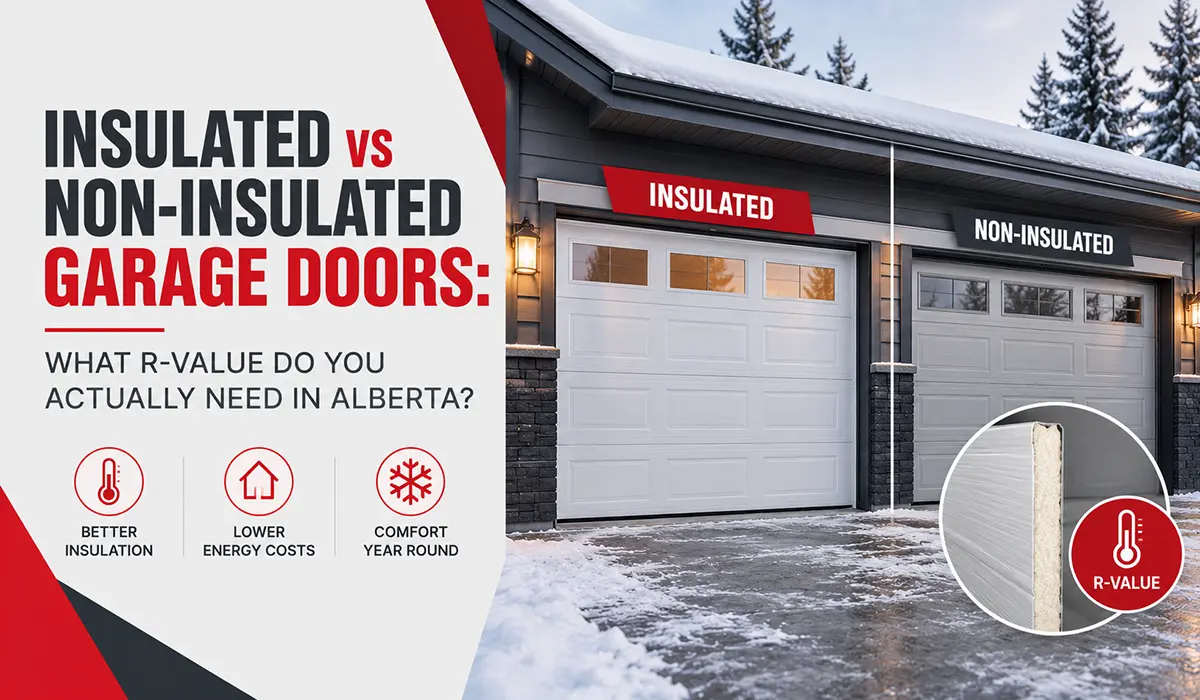
Insulated vs Non-Insulated Garage Doors: What R-Value Do You Actually Need in Alberta?
If you are replacing a garage door in Alberta, the insulation question matters more than almost any other choice you will make. Here is the short version. For an attached garage that you heat, or one with a room above it, aim for an R-16 to R-18 insulated door. For an attached garage you do not heat, R-12 to R-16 is the sweet spot. For a detached, unheated garage used only for storage, you can go as low as R-6, or skip insulation entirely, though even a little brings side benefits. A non-insulated door only makes real sense on a detached shed where warmth, noise, and comfort simply do not matter.
That is the answer most people are looking for. The rest of this guide explains why those numbers make sense for our climate, what R-value actually measures, and the one detail that quietly decides whether your insulated door performs as advertised.
Recommended garage door R-value by garage type in Alberta
| Your garage | Recommended R-value | Why |
|---|---|---|
| Attached and heated, or living space above | R-16 to R-18 | Highest priority. Cuts heat loss, lowers bills, keeps adjoining rooms comfortable |
| Attached but not heated | R-12 to R-16 | Protects the shared wall and helps the whole house feel warmer |
| Detached but heated (shop, gym, office) | R-12 to R-16 | Keeps the heat you pay for inside the space |
| Detached, unheated, storage only | R-6, or none | Warmth is not the goal, but insulation still adds quiet and rigidity |
What “insulated” actually does, beyond keeping you warm
Most people picture insulation as a winter thing only. It does more than that, and understanding the full list helps you decide whether it is worth the extra cost.
It slows heat moving in either direction. In winter it keeps the warmth in. In an Alberta summer it keeps the worst of the heat out, which matters if your garage doubles as a workspace.
It makes the door quieter. An insulated door has more mass and less empty space to rattle, so it opens and closes with a softer sound. It also muffles street noise, which people notice most when the garage sits below a bedroom.
It makes the door stronger. The insulation inside a two or three-layer door stiffens the panels. That means better resistance to denting, less flexing in our southern Alberta winds, and a door that holds its shape over the years.
It reduces frost and condensation. When you heat a garage that has a bare steel door, warm damp air hits the cold metal and frosts up on the inside. An insulated door keeps that interior surface warmer, so you get less frost and fewer puddles under the door.
It protects what is inside. A steadier temperature is easier on your vehicle, on paint and tools, and on anything stored in the space that does not love deep cold.
Insulated vs non-insulated: the real differences
A non-insulated door is a single layer of steel with nothing behind it. It is the cheapest option and the lightest, and on a detached storage garage it does the job. The trade-offs show up the moment warmth, comfort, or noise enters the picture. It offers close to no resistance to heat loss, it drums loudly when it moves, it dents more easily, and it frosts over on the inside if you try to heat the space.
An insulated door adds one or two layers with a foam core between them. It costs more, usually a few hundred dollars more on a steel door, and it weighs more. In return you get warmth, quiet, strength, and far less condensation. For any garage attached to your home, that trade is easy to justify in this climate.
R-value, explained without the jargon
R-value measures how well a material resists heat flow. The higher the number, the harder it is for heat to pass through. That is the whole idea.
Here is roughly where garage doors land:
- Non-insulated, single layer: about R-0 to R-2. Effectively nothing.
- Two layer, with a polystyrene core: about R-6 to R-10.
- Three layer, with a polyurethane core: about R-12 to R-18, with some premium doors reaching close to R-20.
One honest note that manufacturers do not always make clear. The R-value on the brochure is usually measured at the centre of the panel. The door as a whole, including the seams and edges, performs a little lower than that headline figure. It is still a fair way to compare doors against each other, just do not treat the number as the exact warmth of your garage.
What R-value do you actually need in Alberta?
Alberta winters regularly sit below -30°C, and in the south we get chinooks that swing the temperature up and down within a single day. That combination is why insulation carries more weight here than in milder parts of the country. Match the door to how you use the space.
Attached and heated, or a room above the garage. This is where insulation earns its keep. Go for R-16 to R-18, which means a triple-layer polyurethane door. The garage shares a wall, and often a ceiling, with your living space, so heat lost here is heat lost from your home.
Attached but not heated. You are not warming the garage on purpose, but the cold in there still pulls at the adjoining rooms. R-12 to R-16 keeps that shared wall from turning into a cold spot and makes the nearest rooms noticeably more comfortable.
Detached but heated, such as a shop, gym, or home office. If you are paying to heat it, insulate it. R-12 to R-16 keeps that heat inside instead of pouring it out through the door.
Detached, unheated, storage only. Warmth is not the point here. R-6 is plenty, and a plain non-insulated door is a reasonable way to save money. Even so, a bit of insulation makes the door quieter and stiffer, which some owners still find worthwhile.
Polyurethane vs polystyrene: which insulation is better?
Not all insulated doors are built the same, and the type of foam inside makes a real difference.
Polystyrene is a rigid foam board cut to fit and slid into the door sections. It is the more affordable choice, it insulates at roughly R-3.8 to R-4 per inch, and because it is dropped in rather than bonded, it can leave small gaps at the edges.
Polyurethane is foam injected into the door, where it expands to fill every space and bonds the steel skins together. It insulates better, at roughly R-6 or more per inch, and because it is bonded rather than loose, it also makes the door stiffer and quieter. For Alberta winters, polyurethane is the stronger pick, and it is what we usually recommend for an attached or heated garage.
The part most people miss: your seals decide the real R-value
You can buy the warmest door on the market and still have a cold, draughty garage if the seals around it are worn or poorly fitted. This is the detail that quietly undoes a good door.
Air leaks in around the perimeter of the door and along the bottom. The R-value rating does nothing to stop that. What stops it is the weatherstripping down the sides and across the top, and the bottom seal that presses against the floor. Alberta floors are rarely perfectly level, so a bottom seal that fills an uneven gap makes a real difference in how much cold air sneaks under the door.
If your current garage feels cold despite an insulated door, the fix is often not a new door at all. Fresh weatherstripping and a new bottom seal usually bring back more comfort, for far less money, than most people expect. We check these on every service call because they are the most common reason an insulated garage still feels drafty.
Is an insulated garage door worth the extra cost?
For a detached storage garage, honestly, not always. If you never heat it and never spend time in it, a non-insulated door saves you money with little downside.
For everything else, yes. The extra few hundred dollars for insulation buys warmth, quieter operation, a stronger door, and far less frost. If you actually heat the garage, insulation pays you back directly by keeping that heat inside. If the garage is attached, it makes the rooms next to it more comfortable and takes some strain off your home’s heating. Add the longer life you get from a stiffer, better-built door, and the upgrade tends to look like an easy decision for most Alberta homes.
One practical point when you upgrade. Insulated doors are heavier than non-insulated ones, and the springs have to be sized to match that weight so the door stays balanced and the opener is not overworked. This is handled as part of a proper installation, and it is also why adding a DIY foam kit to an old door can throw off the balance. If you go that route, the springs may need adjusting afterward.
A quick way to decide
Run through these questions in order and stop at the first yes.
- Is the garage attached to your home, or heated? Get an insulated door, R-16 to R-18 for heated or a room above, R-12 to R-16 otherwise. Choose polyurethane.
- Is it detached but heated? Insulate it, R-12 to R-16.
- Is it detached, unheated, and just for storage? A non-insulated door or a light R-6 door is fine. Spend your money on good seals instead.
Whatever door you land on, put a bit of the budget toward proper weatherstripping and a solid bottom seal. That is the cheapest comfort you will ever buy.
The bottom line
In Alberta, insulation is the part of a garage door that decides how comfortable, quiet, and durable it is, so for almost any attached or heated garage, an insulated door in the R-16 to R-18 range with a polyurethane core is the choice that makes sense. Non-insulated doors have a place, but a narrow one, on detached garages where warmth is not a concern. And no matter the R-value, the seals around the door are what turn that rating into a garage that actually feels warm.
If you want a straight recommendation for your garage, the team at Alberta Garage Door Services fits and services doors across Calgary, Airdrie, Chestermere, Cochrane, Okotoks, and the surrounding area, and we are glad to walk you through the right R-value and pricing for your space. Contact us for a free quote or call 587 223 5757. If you are still weighing materials, our guide to steel, aluminum, wood, and composite doors for Calgary weather is a good next read.
Frequently asked questions
Do I need an insulated garage door if I don’t heat my garage?
Often yes, especially if the garage is attached to your home. Even without a heater, an insulated door keeps the cold from pulling at the adjoining rooms, makes the door quieter, and adds strength. For a detached, unheated storage garage, a non-insulated door is a reasonable way to save money.
What R-value garage door do I need in Alberta?
For an attached or heated garage, aim for R-16 to R-18. For an attached garage you do not heat, R-12 to R-16 works well. A detached but heated shop or gym does well at R-12 to R-16, and a detached, unheated storage garage is fine at R-6 or with no insulation at all.
Is an insulated garage door worth the extra money?
For any attached or heated garage, yes. The extra cost, usually a few hundred dollars on a steel door, buys warmth, quieter operation, less frost, and a stronger door, and it pays back directly if you heat the space. For a detached storage garage you never use, the upgrade is less necessary.
What is the difference between a single, double, and triple-layer garage door?
A single-layer door is one sheet of steel with no insulation. A two-layer door adds a foam core, usually polystyrene, for moderate insulation and less noise. A three-layer door sandwiches polyurethane foam between two steel skins for the highest R-value, the most strength, and the quietest operation, which makes it the best choice for Alberta winters.
Does an insulated garage door keep the garage warm without a heater?
It will not heat the garage, but it holds warmth much better and stops the space from getting as cold as the outdoors. In an attached garage it also captures some heat that drifts in from the house. To keep a garage at a set temperature you still need a heat source, but insulation makes that heat go much further.
Will an insulated garage door make my garage quieter?
Yes. The foam core adds mass and removes the hollow space that makes a bare steel door rattle, so the door opens and closes more softly. It also muffles outside noise, which is most noticeable when there is a bedroom or office above or beside the garage.
Can I add insulation to my existing garage door?
You can add a foam or panel insulation kit to an existing door, and it will help a little, though it will not match a properly built two or three-layer door. Adding weight this way can also throw off the door’s balance, so the springs may need adjusting afterward to keep the door and opener working safely.
Does garage door insulation help in summer too?
Yes. Insulation slows heat moving in both directions, so in an Alberta summer it keeps the worst of the heat out of the garage. That matters most if you use the space as a workshop, gym, or office, or if the garage sits below a room you want to keep cool.
Why does my insulated garage still feel cold and drafty?
The most common reason is the seals, not the door. Worn side weatherstripping or a gap under the door lets cold air pour in no matter how high the door’s R-value is. Replacing the weatherstripping and bottom seal usually restores comfort for a fraction of the cost of a new door.
Are insulated garage doors heavier, and does that affect the opener?
Insulated doors do weigh more than non-insulated ones. During a proper installation the springs are sized to match that weight so the door stays balanced and the opener is not strained. This is why spring sizing matters whenever you switch to a heavier insulated door.
