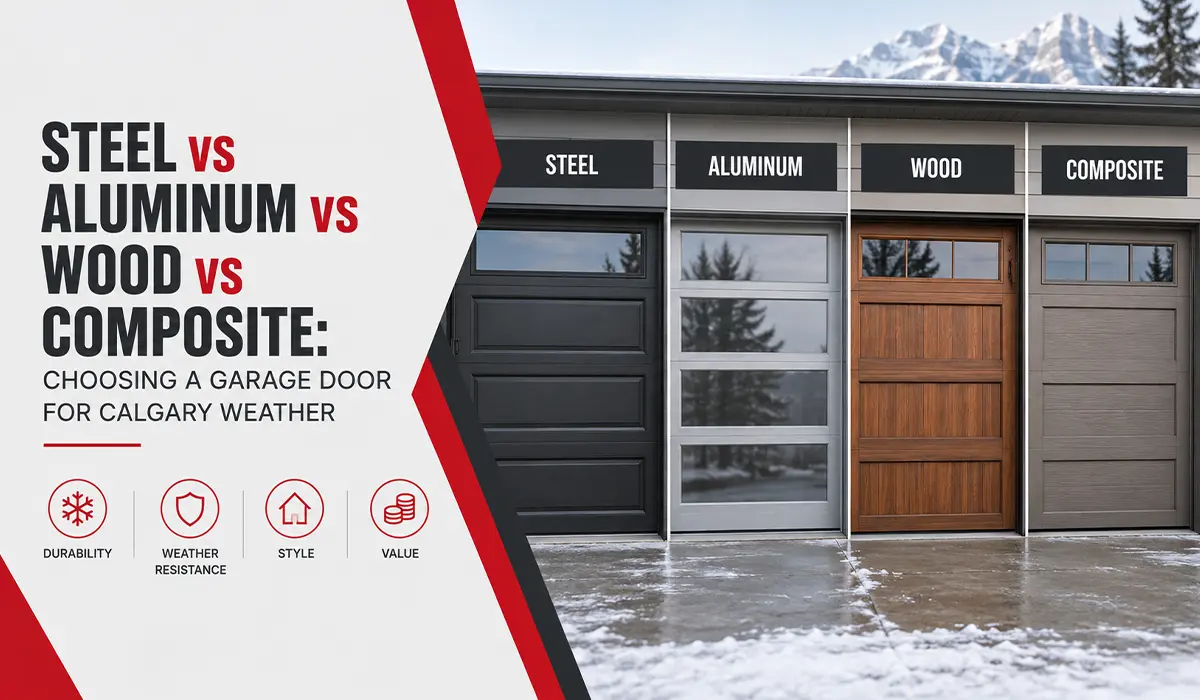
Steel vs Aluminum vs Wood vs Composite: Choosing a Garage Door for Calgary Weather
Picking a garage door in Calgary is not the same as picking one in Vancouver or Toronto. Our winters drop past -30°C, a chinook can lift the temperature 25 degrees in an afternoon, and that same door still has to sit through +30°C July sun a few months later. That kind of swing is hard on materials.
For most Calgary homes, an insulated steel garage door gives the best mix of warmth, strength, and price. Aluminum suits modern, glass-heavy designs but does little to hold heat in. Wood looks beautiful and insulates naturally, but our freeze-thaw cycles and dry air are rough on it, and it needs steady upkeep. Composite gives you the wood look without most of the maintenance, and it holds up well here, though you pay more for it.
The right choice really comes down to three things: your budget, whether the garage is attached and heated, and how much maintenance you are willing to take on. Below is a plain comparison, then a closer look at each material with our climate in mind.
Quick comparison of garage door materials for Calgary
| Material | Insulation | How it handles cold | Maintenance | Rough installed cost (double door) | Best for |
|---|---|---|---|---|---|
| Steel | Very good when insulated | Excellent | Low | From $1,500 | Most Calgary homes, best overall value |
| Aluminum | Poor | Good, but dents easily | Low | From $2,500 | Modern full-view glass designs |
| Wood | Good, natural | Fair, moves with moisture | High | From $4,000 | Character homes, custom looks |
| Composite | Good | Very good | Low | From $3,500 | Wood look without the upkeep |
Costs are approximate and change with door size, insulation level, window inserts, and hardware. For an exact number, it is always worth getting a quote on your specific opening.
Why Calgary weather changes the answer?
In a milder city you can pick a garage door on looks alone. Here, the climate does a lot of the deciding for you.
Deep cold. Calgary sees stretches below -30°C every winter. If your garage is attached or has a room above it, an uninsulated door bleeds heat straight out and drags your energy bills up with it. Insulation is not a luxury add-on in this city, it is the main event.
Chinooks and freeze-thaw. We get warm chinook winds that can push the temperature up 20 to 30 degrees in a single day, then drop it again overnight. That repeated freeze-thaw cycle works its way into anything that holds moisture. Wood swells and shrinks. Weather seals get brittle. Materials that stay dimensionally stable, like steel and composite, cope with this far better.
Summer sun and UV. Our summers are dry and bright. Strong UV fades finishes over time, and dark-coloured doors on a south-facing wall can get very hot, which stresses some materials and voids certain warranties. This matters more than people expect.
Wind. Southern Alberta gets real wind. On wide double doors, wind load rating is worth asking about so the door stays rigid and sealed in a gust.
The short version: in Calgary, insulation and the ability to shrug off big temperature swings matter more than they would almost anywhere else in Canada. Keep that in mind as you read the four options.
Steel garage doors
Steel is the most common garage door in Calgary, and for good reason. It is strong, it is affordable, and when it is built the right way it insulates well.
Steel doors come in three builds. Single-layer doors are one sheet of steel with no insulation and are really only suited to a detached, unheated shop. Two-layer doors add a foam core. Three-layer doors, which are steel, insulation, then steel again, are the ones you want for an attached or heated garage in this climate. The insulation inside is either polystyrene board or injected polyurethane foam. Polyurethane gives a higher R-value in the same thickness, bonds the layers into a stiffer and quieter door, and is the better pick for Calgary winters.
Modern steel doors are galvanized and coated, so rust is rarely an issue if the finish is not damaged. The one real weakness is denting. A hockey puck or a backed-up bumper can leave a mark. The upside is that individual sections can often be swapped rather than replacing the whole door, which keeps repairs affordable. If you dent a panel down the road, our team handles garage door panel replacement without touching the rest of the door.
Best for: almost every Calgary home that wants strong performance for a sensible price. If you are unsure, a triple-layer insulated steel door is the safe, smart default. See our new garage door installation page for what a fitting looks like.
Aluminum garage doors
Aluminum is the material behind those sleek, modern doors with large frosted or clear glass panels. It is light, it will never rust, and it gives a clean contemporary look that steel cannot quite match.
The trade-off is insulation. Aluminum is a metal that conducts cold readily, and full-view glass doors let heat pass right through. On an attached, heated garage in a Calgary winter, an aluminum glass door can frost up and pull warmth out of the space quickly. You can order it with insulated glass to soften this, but you should not expect it to hold heat the way an insulated steel or composite door does. Aluminum also dents more easily than steel because it is softer.
Best for: homeowners who want a specific modern, glass-forward look and are willing to accept weaker insulation, or for a detached showpiece garage where heat loss is not a concern. If you love the style, pair it with insulated glass and tight seals, and go in with clear eyes about the warmth.
Wood garage doors
A real wood door has a warmth and depth of character that nothing else copies exactly. Cedar, hemlock, and mahogany doors look stunning on the right home, and wood insulates naturally.
The problem is that wood and Calgary do not get along easily. Our dry cold followed by damp chinook swings makes wood expand, contract, and eventually warp, crack, or check. To keep it looking good and sealing properly, a wood door needs to be refinished or resealed every couple of years, sometimes sooner on a sun-exposed wall. Wood is also heavy, which puts more strain on the springs and opener, and it sits at the top of the price range.
Best for: owners of character or custom homes who genuinely want wood, understand the upkeep, and are prepared to stay on top of it. If you love the look but not the maintenance, read the next section first, because composite was made for exactly this situation.
Composite and faux-wood garage doors
Composite doors are the answer to a common wish: the beauty of wood without the babysitting. They are built from engineered or recycled wood fibres, or as a wood-look overlay bonded to an insulated steel core, and they are finished to mimic real grain closely.
Because there is little or no natural wood exposed, composite resists rot, warping, and moisture far better than the real thing. It handles our freeze-thaw cycles well, it stays dimensionally stable, and it needs very little maintenance beyond the occasional wash. Insulation is good, often on par with a quality steel door. You pay more than you would for steel, but less than for solid wood, and you skip the refinishing schedule entirely.
There is also a middle option worth knowing about: wood-look insulated steel doors. These give you a printed or textured wood-grain finish on a steel body, so you get steel’s strength and price with a warmer appearance. It is a popular compromise in Calgary.
Best for: homeowners who want the warm, natural look of wood but want it to perform through Alberta winters with almost no upkeep.
What R-value do you actually need in Calgary?
R-value measures how well the door resists heat loss. Higher is better. In our climate, this number matters more than the material name on the brochure. Here is a simple guide.
- Attached garage that is heated, or has living space above it: aim for R-16 to R-18, which usually means a triple-layer polyurethane door. This is where good insulation pays for itself in comfort and energy bills.
- Attached garage that is not heated: R-12 to R-16 is a sensible range. It keeps the cold out of the adjoining wall and helps the whole house feel warmer.
- Detached, unheated garage: R-6 to R-12 is plenty, and even a modest amount of insulation makes the door quieter and stiffer.
One thing many buyers miss: the R-value printed on the door is a lab figure for the panel alone. Real-world performance depends just as much on the seals around it. A well-insulated door with a gap at the bottom or brittle side seals will still let cold air pour in. If your current door is draughty, fresh weatherstripping and a new bottom seal often make a bigger day-to-day difference than the R-value alone.
How to choose: a simple way to decide
Rather than starting from the material, start from what matters most to you. Work down this list and stop at the first line that fits.
- You want the best value and reliable warmth: insulated steel, triple-layer polyurethane, R-16 or higher. This is the right call for most Calgary homes.
- You want a warm, natural wood look with almost no upkeep: composite, or a wood-look insulated steel door.
- You want a modern, glass-forward design and can accept weaker insulation: aluminum with insulated glass.
- You want genuine solid wood and will maintain it: a real wood door, refinished on schedule.
A few extra points to weigh:
- Colour and sun. Dark doors on a south-facing wall soak up a lot of heat in our summers. On some materials and finishes this can cause fading or warranty issues, so ask the manufacturer before you commit to black or a deep charcoal on a sunny side.
- Single vs double. A double door has more surface area losing heat, so insulation matters even more on wide openings.
- Windows. Window inserts look great and let in light, but glass insulates less than a solid panel. If warmth is the priority, keep glazing modest or choose insulated glass.
A few Calgary tips before you buy
- Get the seals right. The best door in the city still leaks if the bottom seal and side weatherstripping are worn or poorly fitted.
- Match insulation to how you use the space. Do not pay for R-18 on a detached storage shed, and do not cheap out on an attached heated garage.
- Plan around the sun for dark colours on south and west walls.
- Use a professional installer. Cold-weather sealing, spring sizing, and door balance are what make a door last through Calgary winters, and a poor install undoes a good door.
The bottom line
For the majority of Calgary homeowners, an insulated steel garage door is the smart choice, and a triple-layer polyurethane build is worth the small extra cost for the warmth it holds. If you want the look of wood without the work, composite is the standout. Aluminum earns its place on modern, glass-forward homes, and solid wood still makes sense for the right character home in the right hands.
If you would like a straight recommendation for your home and opening, the team at Alberta Garage Door Services has fitted doors across Calgary, Airdrie, Chestermere, Cochrane, Okotoks, and the surrounding area, and we are happy to talk through the options and pricing. Contact us for a free quote or call 587 223 5757.
Frequently asked questions
What is the best garage door material for Calgary’s climate?
For most Calgary homes, insulated steel is the best material because it balances strength, warmth, and price, and it stays stable through our cold snaps and chinook swings. Composite is the top choice if you want a wood look with low maintenance, while aluminum suits modern glass designs and solid wood suits character homes where the owner will keep up the maintenance.
What R-value should a garage door have in Calgary?
For an attached or heated garage, aim for R-16 to R-18, which usually means a triple-layer polyurethane door. An unheated attached garage does well at R-12 to R-16, and a detached unheated garage is fine at R-6 to R-12. Remember that seals and weatherstripping affect real-world warmth as much as the R-value itself.
Are steel garage doors good for cold weather?
Yes. Insulated steel doors handle Calgary winters very well, especially triple-layer builds with polyurethane foam, which hold heat and stay rigid in the cold. Modern steel is galvanized and coated so rust is rarely a concern, though the surface can dent from hard impacts.
Do aluminum garage doors work well in Calgary winters?
Aluminum resists rust and looks modern, but it insulates poorly and conducts cold, so it is not ideal as the only barrier on an attached, heated garage. It can frost up and lose heat quickly in deep cold. It works best on detached garages or as a design feature paired with insulated glass.
Is a wood garage door a bad idea in Alberta?
Not a bad idea, but a demanding one. Wood insulates naturally and looks beautiful, but Alberta’s dry cold and freeze-thaw swings cause it to warp, crack, and check over time, so it needs refinishing every couple of years. If you want the wood look without that upkeep, composite is usually the better fit.
How much does a new garage door cost in Calgary?
A new double garage door in Calgary typically runs from around $1,500 for basic insulated steel up to $12,000 or more for solid wood, with composite and aluminum in between. The final price depends on size, insulation level, window inserts, and hardware, so a quote on your specific opening is the only way to be exact.
Should I get an insulated garage door if my garage is detached and unheated?
Insulation still helps even in a detached, unheated garage. It keeps the space a little warmer, makes the door quieter, and adds rigidity so the panels resist bending. You do not need a high R-value there, so R-6 to R-12 is usually plenty.
What is the difference between polyurethane and polystyrene insulation?
Polystyrene is a rigid foam board placed inside the door, and it is the more affordable option with a lower R-value. Polyurethane is foam injected into the door that expands to fill the space, bonding the layers together for a higher R-value, a stiffer door, and quieter operation. For Calgary winters, polyurethane is the stronger choice.
How long does a garage door last in Calgary?
A quality insulated steel or composite door commonly lasts 20 to 30 years in Calgary with basic care, while the springs and opener usually need service or replacement sooner. Wood doors can last a long time too, but only with regular refinishing to protect them from our climate.
Does a dark garage door colour cause problems in the sun?
It can. Dark doors on south and west-facing walls absorb a lot of heat during Calgary summers, which can fade finishes and, on some materials, stress the panels or affect the warranty. If you want a dark colour on a sunny wall, check the manufacturer’s guidance before ordering.
