
What Size Garage Door Do I Need? Standarad Sizes and How to Measure
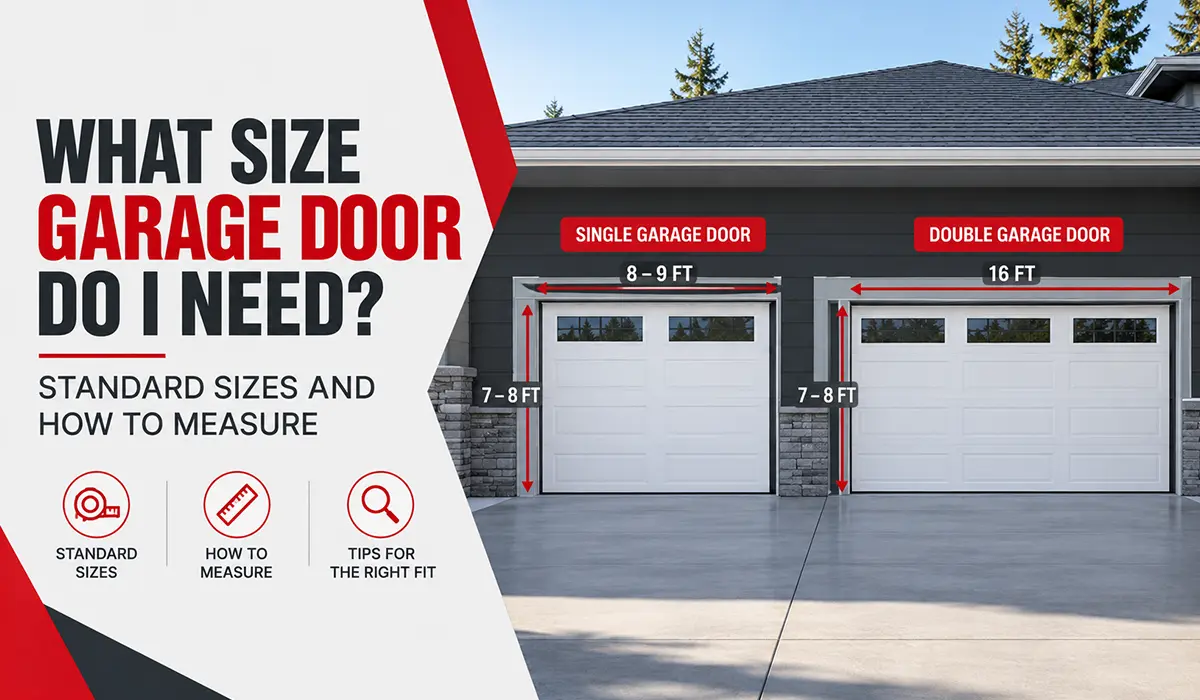
The most common garage door sizes are 9 by 7 feet for a single door and 16 by 7 feet for a double door. Many newer homes also use 8 feet high doors for taller vehicles. To find the size you need, measure the width and height of your opening, then check the headroom above the door, the room behind it and the space on each side. If your numbers land between standard sizes, you can usually fit the closest standard door, or order a custom size.
This guide gives you the standard size chart, a simple way to measure, and the mistakes that cause a door to show up the wrong size.
Standard Garage Door Sizes
Residential garage doors in Canada are sold in feet and inches, and most are built in set widths and heights. Here are the sizes you will see most often.
| Door type | Common sizes (width by height) | Metric (approx.) | Fits |
|---|---|---|---|
| Single | 8 x 7 ft | 2.4 x 2.1 m | One compact or mid-size car |
| Single | 9 x 7 ft | 2.7 x 2.1 m | One car or SUV, the most common single size |
| Single | 9 x 8 ft | 2.7 x 2.4 m | One tall SUV or truck |
| Single (wide) | 10 x 7 ft or 10 x 8 ft | 3.0 x 2.1 or 2.4 m | A full-size truck or van |
| Wide single | 12 x 7 ft or 14 x 7 ft | 3.7 or 4.3 x 2.1 m | Large trucks, boats, small trailers |
| Double | 15 x 7 ft | 4.6 x 2.1 m | Two smaller cars, tight fit |
| Double | 16 x 7 ft | 4.9 x 2.1 m | Two cars, the most common double size |
| Double | 16 x 8 ft | 4.9 x 2.4 m | Two cars with taller vehicles |
| Double (wide) | 18 x 7 ft or 18 x 8 ft | 5.5 x 2.1 or 2.4 m | Two large vehicles |
| RV or oversized | 12 x 12 ft, 14 x 12 ft | 3.7 or 4.3 x 3.7 m | RVs, large trailers |
Sizes can vary a little by brand, and some manufacturers offer extra sizes. Older homes may have doors that are 6 ft 6 in high, or widths that do not match anything in the chart. If that is you, measure carefully (steps below) instead of going by the age of the house.
Single Car Garage Door Size
For one vehicle, 9 by 7 feet is the standard pick on most homes. An 8 by 7 door is common on older garages, but it leaves very little room for mirrors. If you drive a full-size truck or SUV, move up to a 10 foot width.
Double Car Garage Door Size
A 16 by 7 foot door is the usual size for a two-car garage. You get enough width for two vehicles to pull in without a perfect line each time. If you drive two larger vehicles, an 18 foot width gives more room.
Some homes have two single doors instead of one double. Two singles give you a post between the vehicles and a bit more wall strength, but they cost more in hardware and openers. A single wide door is simpler and gives you more clear space.
Oversized, RV and Commercial Sizes
Doors wider than 14 feet or taller than 8 feet usually come as special orders. They weigh more, need heavier springs and hardware, and can take longer to arrive. If you plan to store an RV, boat or work truck, tell your installer what you own so the size, track and springs are matched to it.
What Size Fits Your Vehicles?
Most garage door problems come from choosing a size that works on paper and feels tight in real life. Think about your mirrors, your passengers, and the snow and ice that build up in a Calgary winter.
| Vehicle | Suggested width | Suggested height |
|---|---|---|
| Compact car | 8 to 9 ft | 7 ft |
| Mid-size SUV or sedan | 9 ft | 7 ft |
| Full-size SUV | 9 to 10 ft | 7 to 8 ft |
| Full-size pickup | 10 ft (single) or 16 to 18 ft (double) | 7 to 8 ft |
| Lifted truck, van or roof rack | 10 ft plus | 8 ft |
| Two mid-size vehicles | 16 ft | 7 ft |
| Two large trucks or SUVs | 18 ft | 8 ft |
A full-size pickup is often about 6.5 to 7 feet wide before the mirrors, and over 8 feet with mirrors out. That is why an 8 foot door feels tight and a 9 or 10 foot door feels easy. If you have a roof box, ladder rack or a lifted vehicle, measure its height with the load on before you pick a door height.
What You Need to Measure
Six measurements decide which door will fit.
| Measurement | What it is | Why it matters |
|---|---|---|
| Opening width | The width of the finished opening, side to side | Sets the door width |
| Opening height | Floor to the top of the opening | Sets the door height |
| Headroom | Space from the top of the opening to the ceiling or the first obstruction | Decides the track and spring type |
| Backroom | Space from the opening back into the garage | Needs to fit the open door and opener |
| Side room | Space on each side of the opening to the wall | The vertical track and brackets mount here |
| Opening depth | The jamb or wall thickness | Helps with trim and weatherstripping |
Headroom, Backroom and Side Room
These three are the ones people forget.
- Headroom: Most standard torsion spring systems need about 12 inches (30 cm) above the opening. If you have less, low-headroom kits can work with roughly 4 to 6 inches, but they are a different setup and cost more.
- Backroom: A good rule is the door height plus about 18 inches. For a 7 foot door, that is about 8 feet 6 inches of clear space behind the opening, with room for the opener too.
- Side room: Plan for roughly 3.75 inches on each side of the opening, and a bit more for some track systems.
Pipes, ducts, lights, beams and the garage ceiling can all block the track. Look for them before you order.
How to Measure for a New Garage Door
You need a tape measure, a pencil, paper and ideally a helper. Measure inside the garage with the door closed.
- Measure the width. Measure the finished opening from one side to the other at the top, middle and bottom. Write down the smallest number. Take it to the nearest 1/8 inch.
- Measure the height. Measure from the floor to the top of the opening at the left, centre and right sides. Garage floors slope, so these numbers can be different. Use the smallest.
- Measure the headroom. Measure from the top of the opening to the ceiling or to the lowest obstruction above it, such as a pipe or beam.
- Measure the backroom. Measure from the opening straight back to the rear wall or the first obstruction. Compare it to the door height plus 18 inches.
- Measure the side room. Measure from each side of the opening to the nearest wall or obstruction.
- Check the existing door. Many doors have a label or sticker inside the bottom section that lists the size. You can also measure the old door’s width and height, and compare it to the opening.
- Look at the jambs and trim. If the jamb is rotted, bent or damaged, say so. It may need repair when the new door goes in.
- Take photos. Photos of the opening, the ceiling space, the tracks and the springs help the installer plan the job.
Standard doors are built to fit standard openings. If your opening is within an inch or two of a standard size, an installer can often fit the nearest door with trim or jamb adjustments. A bigger gap may need framing work or a custom door.
What If Your Opening Is Not a Standard Size?
You have three options.
- Order a custom door. This gives a door built to your exact size, but it costs more and takes longer.
- Use the closest standard door and adjust the opening. Shim, trim or re-frame the opening to fit.
- Change the opening size. This is the biggest job. It needs new framing and a new header above the door to carry the load. Check with the City of Calgary about permit requirements before you start. A licensed contractor should handle this work.
Do not cut or enlarge the opening yourself without a plan for the header. The wall above carries weight.
Does Door Size Change the Price, Springs and Opener?
Yes, in three ways.
Price. Wider and taller doors use more material, so they cost more. Size is one of the things that moves the price, along with insulation, windows and style. A new door from Alberta Garage Door Services starts from $2,200 plus 5% GST. Our new garage door cost guide for Calgary explains what changes the price.
Springs. A bigger door is heavier, and the springs have to match the weight exactly. Springs that are too weak or too strong leave the door out of balance, which is hard on the opener and unsafe. Spring work is dangerous and should be left to a technician. See our guide to garage door spring replacement for what it involves.
Opener. Most residential openers handle standard single and double doors. Heavier insulated doors, 16 foot wide doors and oversize doors may need a stronger opener. Check the rating before you buy. See our garage door opener page for options.
Size and Style Go Together
Once you know the size, you can pick the finish. A few things change with size:
- Windows. The number and layout of windows depends on how many sections and panels the door has. Our guide to garage door window inserts covers styles and glass choices.
- Insulation. Wider doors lose more heat if they are uninsulated. In Calgary, an insulated door is worth the extra cost for a heated or attached garage.
- Colour. A large double door has a big effect on how a home looks.
Common Measuring Mistakes
- Measuring the old door instead of the opening
- Measuring only once, or only at one height
- Forgetting the headroom, backroom or side room
- Ignoring beams, pipes or ceiling lights
- Not measuring at the floor, where the opening can be narrower
- Choosing the same size without checking whether your vehicles fit now
- Rounding up instead of using the smallest measurement
- Cutting or changing the opening without a header plan
Replacing One Panel or the Whole Door?
If your door size is fine and only one section is damaged, a panel replacement may be enough. If the size is wrong, the door is old or several sections are damaged, a full replacement is better. Our guide to replacing a garage door panel vs the full door can help you decide.
Garage Door Size: Frequently Asked Questions
What is the standard size of a garage door?
The most common sizes are 9 by 7 feet for a single door and 16 by 7 feet for a double door. Many homes also use 8 foot high doors for taller vehicles.
What size garage door do I need for one car?
A 9 by 7 foot door suits most cars and SUVs. If you drive a full-size truck, a 10 foot wide door gives more room for mirrors.
What size garage door do I need for two cars?
A 16 by 7 foot door is the most common choice. If you drive two large vehicles, consider an 18 foot door, or 8 feet high if they are tall.
How do I measure for a new garage door?
Measure the width and height of the opening at several points and use the smallest numbers. Then measure the headroom, backroom and side room. Take photos and share them with your installer.
How much headroom do I need for a garage door?
Most standard systems need about 12 inches above the opening. Low-headroom kits can work with about 4 to 6 inches, but they use a different track and spring setup.
Can I install a different size garage door than the one I have?
Yes, but a different size means changing the opening. You may need new framing and a new header, and a permit in Calgary. A licensed contractor should handle it.
Are garage doors a standard size?
Most are built in standard widths and heights, but sizes vary slightly by brand, and older homes can have non-standard openings. Custom sizes are available.
Does a bigger garage door cost more?
Yes. Wider and taller doors use more material and often need stronger springs and hardware. Insulation, windows and style also affect price.
Need Help Measuring or Replacing Your Garage Door in Calgary?
Alberta Garage Door Services measures, supplies and installs garage doors across Calgary and nearby communities including Airdrie, Chestermere, Cochrane, Okotoks, Strathmore and High River. If you are not sure about your size, we can check your opening, headroom and vehicles before you order.
Call or request a free quote online.
